Pricing strategy brief

Pricing decisions get expensive fast. BriefGen helps you recommend the next move with clearer tradeoffs.

Use BriefGen for pricing-model, packaging, discounting, expansion, and rollout-timing questions when you want a recommendation-first brief before the next client or stakeholder discussion.

  • Pricing model tradeoffs
  • Packaging and tiers
  • Rollout timing
  • Shareable PDF
  • No subscription

Best fit

Built for pricing calls that need an actual recommendation

Pricing work usually has multiple defensible options. BriefGen is useful when you need the recommendation, the tradeoffs, and the likely downside cases in a cleaner order.

Raise price now or fix packaging first?

Useful when the team knows monetization needs work, but the biggest question is sequencing. Often the best move is not simply charging more right away.

  • Compare price increase, packaging, onboarding, and rollout options
  • Clarify what would change the recommendation
Seat-based vs usage-based decisions

Helpful when an AI or workflow product has expansion upside but also real risk of cost anxiety, customer confusion, or procurement friction.

  • Weigh expansion potential against churn and buying-complexity risk
  • Turn abstract pricing philosophy into a practical call

Discounting, enterprise tiers, and rollout timing

Good fit when the client is considering premium packages, annual-plan incentives, or enterprise add-ons and wants a cleaner recommendation before rolling anything out.

  • Pressure-test tier design and rollout sequencing
  • Spot where discounting could mask a packaging problem instead of fixing it

Example questions

Pricing questions that fit BriefGen especially well

These are usually strong fits when the answer needs to balance revenue upside with conversion, retention, implementation complexity, and stakeholder buy-in.

Price increase timing

Should a vertical SaaS client raise prices now, or tighten packaging and onboarding first to avoid increasing churn risk?

It forces a practical sequencing call instead of defaulting to 'do both eventually.'

Use this example in BriefGen

Pricing model design

Evaluate seat-based versus usage-based pricing for an AI workflow product and recommend which model is more likely to improve expansion revenue without increasing churn.

This is exactly the kind of tradeoff-heavy question where a recommendation matters more than a feature list.

Use this example in BriefGen

Annual-plan incentive

Should this SaaS company push annual prepay harder next quarter, or would that hide a packaging and adoption problem that needs fixing first?

Good fit when the team is tempted by a revenue shortcut that may create misleading signals.

Use this example in BriefGen

Tier architecture

Is it smarter to add an enterprise tier now, or simplify the existing pricing page and sales handoff before expanding the offer?

Useful when the real issue might be clarity and readiness, not the absence of another tier.

Use this example in BriefGen

Sample proof

Want to judge the product by a real brief first?

Start with the Standard sample. It is the clearest proof of what BriefGen actually delivers: a recommendation-first brief that is easier to skim, forward, and discuss than a raw chat transcript.

Best first lookGrowth prioritizationStandard sample

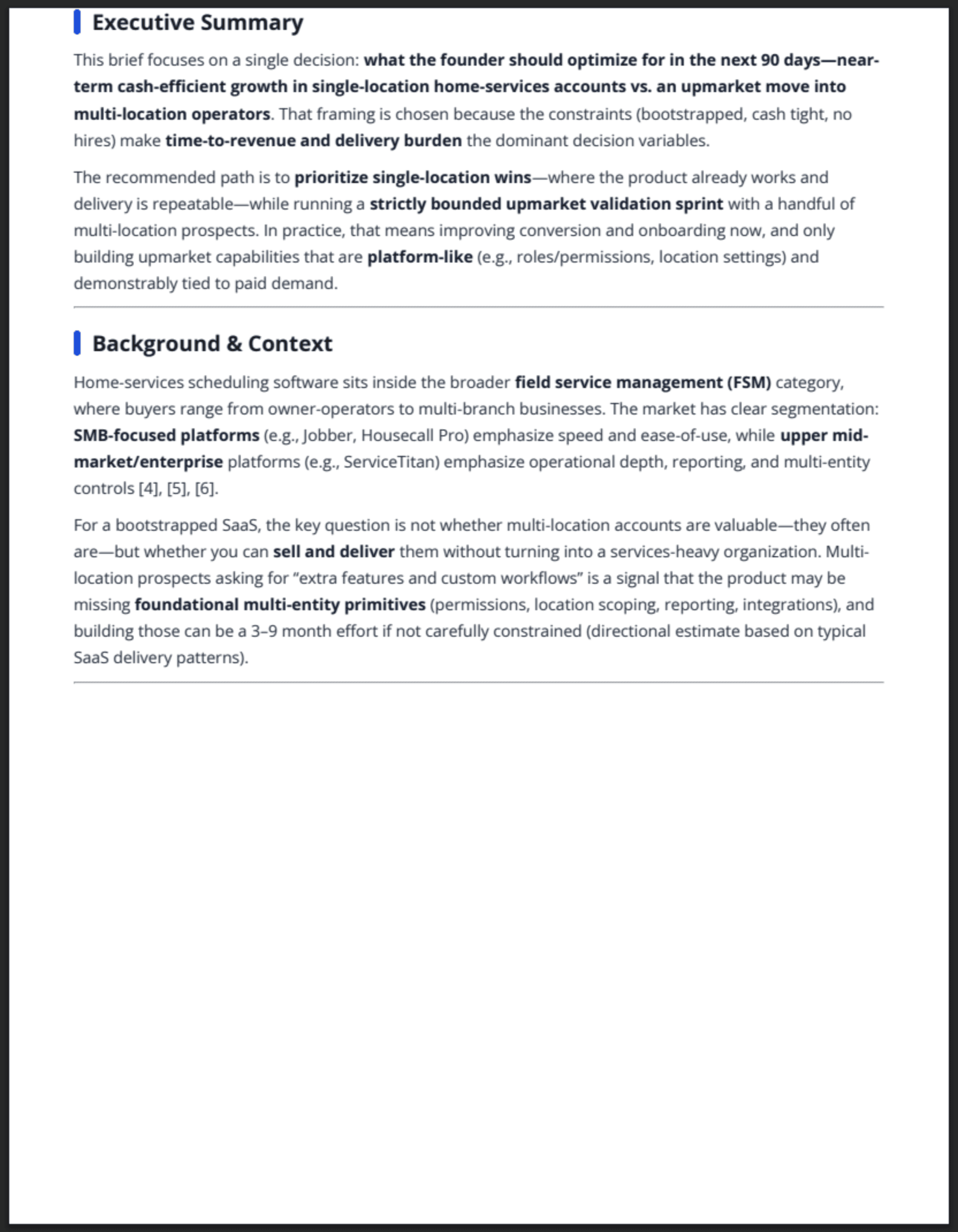
Standard Sample: SMB vs. Upmarket Growth Brief

This is the clearest first-look sample: a fast, skimmable brief that gives a founder or operator a bottom-line recommendation, tradeoffs, and next steps without turning into a mini consulting deck.

  • Shows what buyers get when they need a sharp call fast, not a long research project.
  • Keeps the recommendation, risks, and next steps easy to skim and easy to forward.
  • Makes the Standard tier feel useful and concrete, not watered down.

Standard first-look samplePage 5

Real PDF sample
Standard sample page summarizing the recommendation, risks, and decision criteria

Standard vs Premium

Use Standard for the fast pricing read. Use Premium when the pricing call is more expensive to get wrong.

Both tiers help you get to a recommendation faster. Premium makes more sense when the pricing decision has deeper revenue, churn, or rollout implications.

Both include

  • Shareable PDF delivered by email
  • Recommendation first, not a rambling brainstorm
  • Tradeoffs and sources included
  • Pay once, no subscription or account setup required

Standard

$10

Pay once

Best for a first-pass pricing recommendation before a client meeting, internal memo, or next working session.

  • Fast recommendation with tradeoffs and next steps
  • Good for packaging, page clarity, and sequencing questions
  • Useful when you want a sharper call the same day

Premium

$25

Pay once

Best for higher-stakes pricing calls where you want deeper downside framing, scenario analysis, and more defensible structure before acting.

  • Better for pricing-model changes and rollout-risk questions
  • Adds deeper decision support for bigger monetization moves
  • Useful when the wrong pricing move is materially costly

FAQ

Pricing-page questions buyers and consultants usually ask

The goal is not to turn pricing work into a commodity. It is to help you get to a clearer first recommendation faster.

What context should I include for a pricing brief?

Include customer type, current model, pricing page structure, sales motion, retention concerns, known constraints, and what kind of move is on the table. Pricing recommendations get much better when the business model and current bottlenecks are explicit.

Can BriefGen compare competitor pricing and packaging?

Yes, when public information exists. It is especially useful for comparing visible pricing models, positioning cues, packaging logic, and likely buyer tradeoffs. It is less useful for hidden discounting behavior or internal unit economics you have not provided.

When should I choose Premium for a pricing question?

Choose Premium when the decision has wider revenue, retention, or rollout implications, when you want deeper scenario framing, or when the recommendation needs to be more defensible before it influences a real pricing change.

Is this only for SaaS pricing?

SaaS and recurring-revenue offers are the strongest fit right now, especially when the question involves packaging, monetization sequencing, or segment-specific pricing tradeoffs. Other business models can still work if the decision is concrete and the context is clear.

Can I use this before a client workshop or pricing session?

Yes. That is one of the strongest use cases. It helps you walk in with a sharper recommendation, clearer tradeoffs, and better questions for the live discussion.

Related pages

Explore adjacent BriefGen use cases

If this page is close to the problem you are solving, these related pages usually sit right next to it in the same decision workflow.

BriefGen for consultants

A consultant-focused entry point for pricing, GTM, positioning, and market questions that need a sharper recommendation before the next client conversation.

View page

GTM strategy briefs

Faster recommendation-first GTM briefs for ICP focus, channel prioritization, conversion path, and execution sequencing questions.

View page

Competitive positioning briefs

Recommendation-first positioning briefs for differentiation, category framing, niche focus, and go-to-market messaging decisions.

View page

Ready to test it?

Start with the real pricing question

If the debate is about what to change first, what to test, and what might break if you move too fast, BriefGen is built for that kind of pricing decision.