Competitive positioning brief

Use BriefGen when the positioning question is really about what to claim, what to narrow, and what to stop saying.

Built for positioning, category, and competitor-comparison questions where the goal is a clearer recommendation on how to frame the offer—not a pile of vague messaging ideas.

  • Competitive framing
  • Positioning tradeoffs
  • Niche focus
  • Forwardable PDF
  • No subscription

Best fit

Built for positioning questions with real downside if you frame the offer badly

Positioning decisions often look like copy questions on the surface but are really strategy questions underneath. BriefGen is useful when you need a cleaner recommendation on the underlying move.

Niche down or stay broad?

Useful when a consultancy, agency, or SaaS company is considering narrowing around a segment, category, or buyer type but wants a clearer recommendation on timing and tradeoffs.

  • Compare focus-driven upside against near-term revenue risk
  • Clarify when narrower positioning is likely to help versus hurt
Category framing and differentiation

Helpful when the company can plausibly describe itself in multiple ways and needs a clearer call on which frame creates the best combination of clarity and differentiation.

  • Pressure-test category fit against distinctiveness
  • Reduce generic 'better, faster, easier' messaging drift

Competitive contrast before a messaging refresh

Good fit when you want a structured outside read on how to frame the offer against visible competitors before rewriting everything.

  • Get to a recommendation before launching a full copy project
  • Spot where the current message is too broad or too derivative

Example questions

Positioning questions that benefit from recommendation-first structure

These are strongest when the real need is not more copy options. It is a better call on how the offer should be framed and what tradeoffs come with that choice.

Agency niche decision

Should this boutique growth agency narrow around one B2B SaaS niche this quarter, or keep a broader offer while demand is inconsistent?

This is a classic positioning tradeoff where timing and downside matter more than generic brand advice.

Use this example in BriefGen

Category story

Should this workflow product position itself as an AI copilot, an automation platform, or a compliance workflow tool for enterprise buyers?

Good fit when category clarity and differentiation are pulling in different directions.

Use this example in BriefGen

Enterprise versus mid-market framing

Should this SaaS company lean harder into enterprise-grade messaging now, or keep the current mid-market-first positioning until implementation maturity is stronger?

Useful when the risk is attracting the wrong buyers before the product and sales motion are ready.

Use this example in BriefGen

Competitive contrast

Which positioning angle is more likely to stand out against incumbent scheduling tools: simpler execution, niche specialization, or higher-trust coordination?

Strong fit when the answer needs to compare differentiation with buyer believability.

Use this example in BriefGen

Sample proof

Want to judge the product by a real brief first?

Start with the Standard sample. It is the clearest proof of what BriefGen actually delivers: a recommendation-first brief that is easier to skim, forward, and discuss than a raw chat transcript.

Best first lookGrowth prioritizationStandard sample

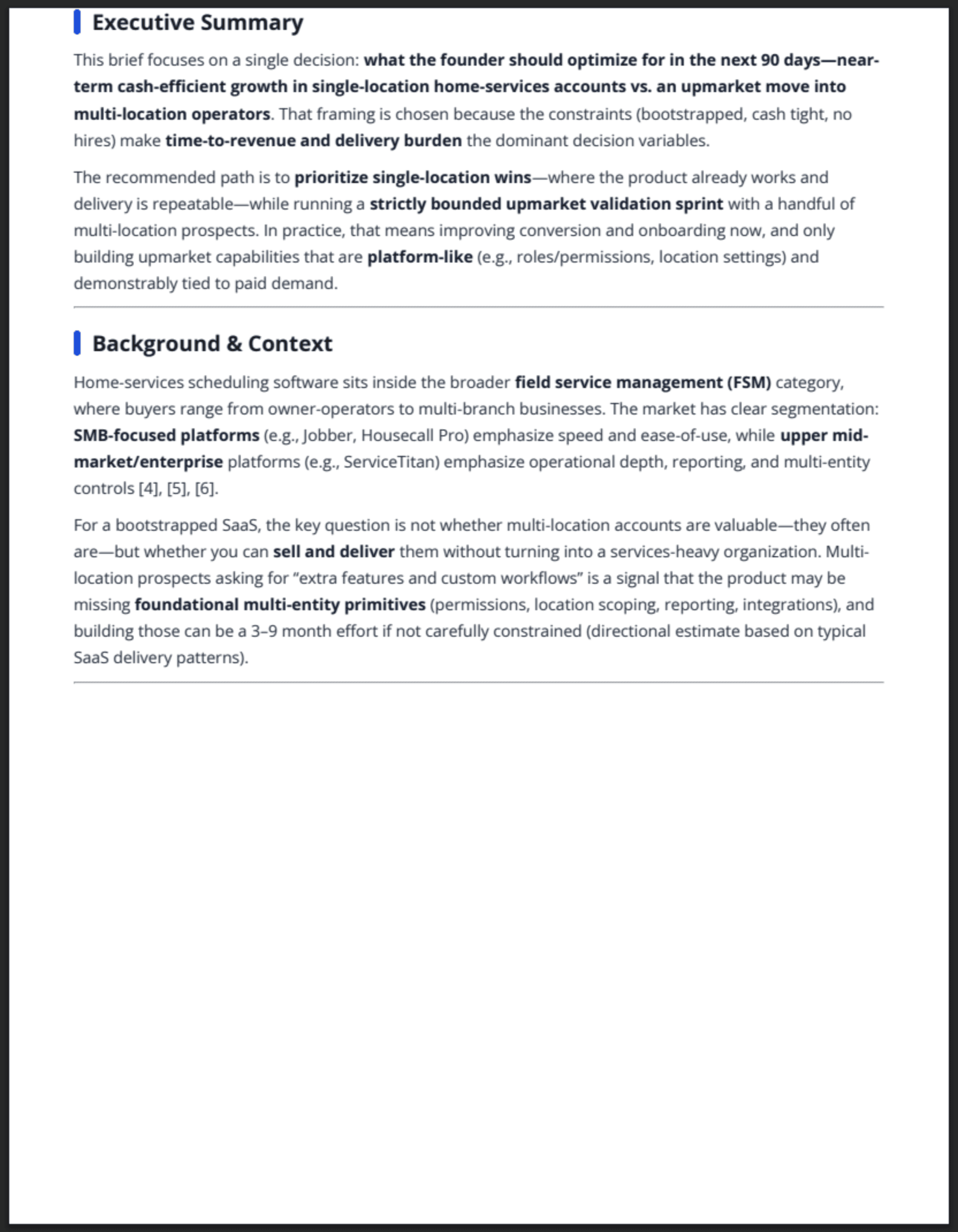
Standard Sample: SMB vs. Upmarket Growth Brief

This is the clearest first-look sample: a fast, skimmable brief that gives a founder or operator a bottom-line recommendation, tradeoffs, and next steps without turning into a mini consulting deck.

  • Shows what buyers get when they need a sharp call fast, not a long research project.
  • Keeps the recommendation, risks, and next steps easy to skim and easy to forward.
  • Makes the Standard tier feel useful and concrete, not watered down.

Standard first-look samplePage 5

Real PDF sample
Standard sample page summarizing the recommendation, risks, and decision criteria

Standard vs Premium

Use Standard for fast positioning calls. Use Premium when the framing decision has bigger commercial consequences.

Both tiers help you get to a cleaner recommendation. Premium is more useful when the positioning choice could shape a broader go-to-market move or higher-stakes narrative change.

Both include

  • Shareable PDF delivered by email
  • Recommendation first, not a rambling brainstorm
  • Tradeoffs and sources included
  • Pay once, no subscription or account setup required

Standard

$10

Pay once

Best for a fast positioning recommendation you can use before a strategy session, client call, or messaging refresh.

  • Good for niche, category, and framing questions
  • Fast recommendation with tradeoffs and next steps
  • Useful when you want sharper structure before doing more work

Premium

$25

Pay once

Best for higher-stakes positioning decisions where the wrong narrative could affect sales motion, category entry, or strategic focus.

  • Adds deeper downside framing and scenario thinking
  • Better for more consequential category or segment shifts
  • Useful when the recommendation needs to be more defensible before rollout

FAQ

Competitive-positioning questions people usually ask first

The strongest fits are real framing decisions tied to commercial tradeoffs, not requests for generic brand poetry.

What context should I include for a positioning brief?

Include current positioning, target buyers, known competitors, category language already in use, sales constraints, and what decision is actually on the table. Positioning recommendations improve a lot when the buyer and commercial context are clear.

Can BriefGen compare competitors?

Yes, especially when competitors have public positioning, category claims, pricing pages, and messaging cues that can be compared. It is less useful for hidden sales narratives or non-public win-loss data you have not provided.

When should I choose Premium for a positioning question?

Choose Premium when the framing decision could materially affect category strategy, target segment, sales motion, or a broader brand and go-to-market shift.

Is this only for SaaS companies?

No, but SaaS and services businesses with visible category and competitor tradeoffs are the strongest fit today because those questions tend to translate well into recommendation-first briefs.

Can I use this before rewriting the site or pitch?

Yes. That is one of the best use cases. It helps you decide what the positioning should actually be before you invest time rewriting everything around a shaky narrative.

Related pages

Explore adjacent BriefGen use cases

If this page is close to the problem you are solving, these related pages usually sit right next to it in the same decision workflow.

BriefGen for consultants

A consultant-focused entry point for pricing, GTM, positioning, and market questions that need a sharper recommendation before the next client conversation.

View page

Pricing strategy briefs

Recommendation-first pricing and packaging briefs for when the real decision is what to change first, what to test, and what not to break.

View page

GTM strategy briefs

Faster recommendation-first GTM briefs for ICP focus, channel prioritization, conversion path, and execution sequencing questions.

View page

Ready to test it?

Start with the positioning decision underneath the copy problem

If the real question is how to frame the offer, where to narrow, or what to emphasize against competitors, BriefGen is built for that kind of positioning call.